Bluetooth Codecs and ANC: What Actually Changes What You Hear?
Editorial guide · researched through 2026-10-23. No first-hand testing or live prices are claimed. Manufacturer specifications and independent research are distinguished below. Regional, software and…
Editorial guide · researched through 2026-10-23. No first-hand testing or live prices are claimed. Manufacturer specifications and independent research are distinguished below. Regional, software and configuration differences may apply.
Bluetooth headphone shopping is full of acronyms whose significance changes depending on the phone, firmware, music and listening environment. A codec converts audio into a wireless data stream; ANC uses microphones and signal processing to reduce environmental noise. Neither can make poor earbud fit disappear. The best purchase is usually the headset that offers consistent comfort, reliable connectivity and the features your exact source supports, not the largest cluster of codec logos.

Quick decision table
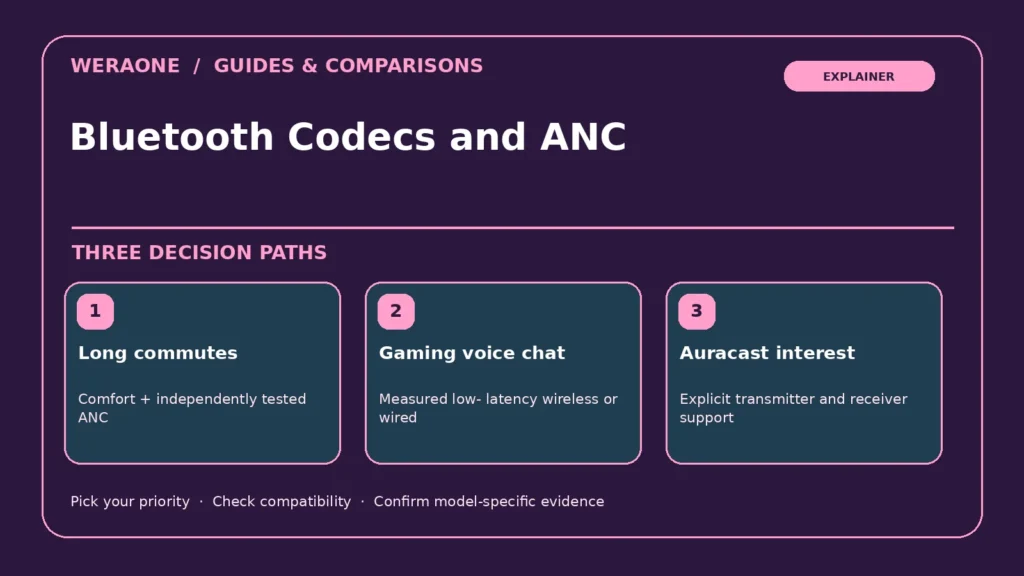
| Priority / scenario | Practical approach | Verify before purchase |
|---|---|---|
| Long commutes | Comfort + independently tested ANC | Codec logo is secondary |
| Gaming voice chat | Measured low-latency wireless or wired | Multipoint and headset mic behavior |
| Auracast interest | Explicit transmitter and receiver support | Version number alone is insufficient |
Codec negotiation is a two-sided contract
SBC is a common baseline for classic Bluetooth audio. AAC, aptX variants and LDAC add different encoding options, but the headphones and transmitting device must both support a compatible mode. Some high-bitrate settings may trade robustness for available quality; software and radio conditions also matter. The codec name alone does not establish audible superiority over a well-tuned alternative. A phone advertising one codec does not make every headphone use it, and a headset supporting a mode may fall back during multipoint use or calls. Verify the active codec in the operating system where possible.
LE Audio and LC3 are an ecosystem shift
Bluetooth LE Audio introduces audio capabilities based on the LC3 codec and enables features such as Auracast broadcast audio on supported systems. The Bluetooth SIG's LE Audio documentation makes clear that real interoperability involves compatible profiles, transport modes and configurations. A device marked "Bluetooth 5.3" does not automatically have usable Auracast receiver or transmitter support. Phones, hearing products, earbuds and venues may implement different roles at different times. Buy for an announced, working feature rather than an assumption that a future firmware update will enable it.
ANC is measurable but fit-sensitive
Effective ANC reduces outside sound using microphones and controlled counter-signals; passive seal and earcup isolation also matter. It often handles steady low-frequency noise particularly well, but speech and unpredictable transients can remain audible. A quoted dB reduction figure without frequency curve and test setup is poor evidence. Independent measurements can compare noise attenuation under repeatable conditions, but your ears, glasses, hairstyle or tip size can alter the seal. Transparency mode quality and wind handling may matter more than maximum ANC during cycling or street use.
Low latency is not one number
Gaming latency includes audio buffering, operating-system processing, codec, radio scheduling and device playback. A low-latency advertised mode may only work with particular phones or USB transmitters. Bluetooth LE Audio can offer different profiles and capabilities, but the word "LE" does not imply zero delay. For competitive gaming and synchronized monitoring, a wired connection or purpose-built 2.4 GHz dongle can be a better, simpler choice. Independent testing should specify connection mode and source hardware, because otherwise comparison numbers have little meaning.
The purchase checklist
Verify phone and computer compatibility, codecs actually negotiated, microphone in windy and busy environments, app support, replaceable tips and battery behavior with ANC enabled. Check multipoint during meetings and whether its use disables high-bandwidth modes. For travel, comfort and passive isolation may be worth more than codec diversity. For music production, wireless headphones can introduce delay or unpredictable monitoring behavior; wired studio headphones remain useful. No listening, frequency-response or latency measurement is invented in this guide.
Before you pay: verification checklist
- Check active codec on your source device
- Read independent ANC and microphone tests
- Confirm LE Audio/Auracast roles explicitly
- Test multipoint with your actual laptop and phone
Frequently asked questions
Does LDAC guarantee lossless music?
No. Codec implementation and the source chain matter; the name is not a guarantee of lossless end-to-end playback.
Does ANC block every noise?
No. Attenuation changes with frequency, design, fit and environment.
Related WeraOne decision guides
Sources and further reading
These links document the technical claims and cited independent research. Product-specific availability and prices are not verified here.
- Bluetooth SIG: Introduction to LE Audio 2.0 — LC3 and LE Audio interoperability and configurations (standards).
- RTINGS: The Best Headphones of 2026 — Listening, ANC, mic and battery findings from testing (independent).
Source review date: 2026-10-23. Draft only; verify current firmware, product revisions, pricing and local availability before publication.